

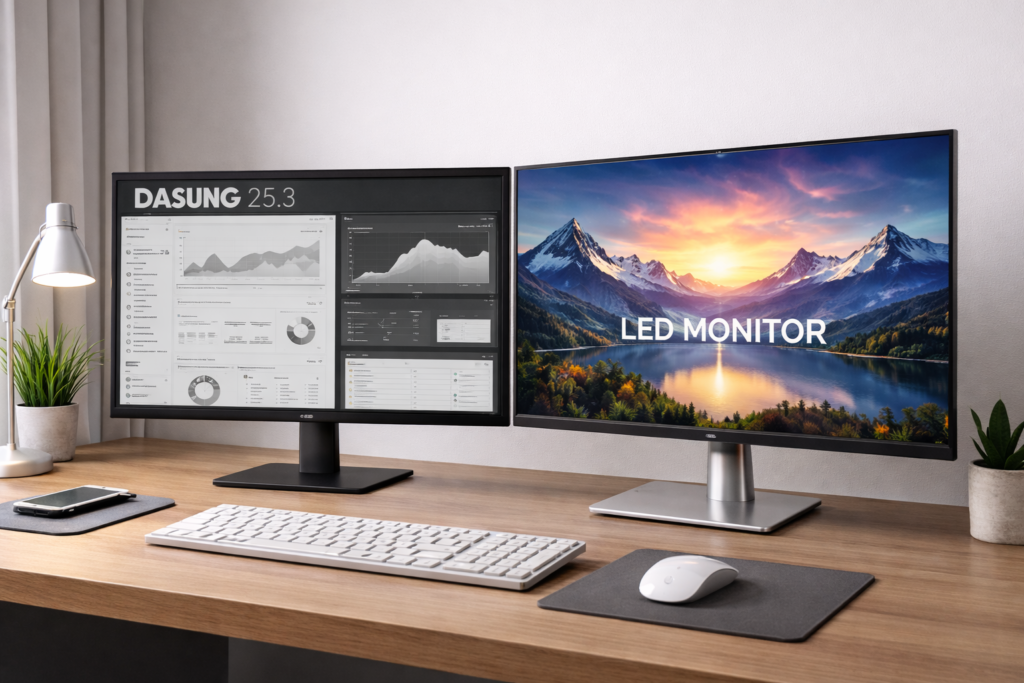
When comparing E‑Ink monitors to traditional LED (LCD) monitors, one of the biggest surprises for many shoppers is the price difference. At first glance, E‑Ink displays look simpler—often black‑and‑white or muted color, slower refresh rates, and fewer features than LED displays. Yet they often cost more. Let’s break down why that is and what you’re really paying for.
1. Completely Different and Specialized Technology
E‑Ink (electronic ink) displays use a fundamentally different technology than LED. Instead of a backlit panel, E‑Ink screens consist of tiny microcapsules filled with charged particles that reflect ambient light. This makes them look more like paper than a glowing screen, and they only consume power when the image changes, not while displaying it.
This reflective technology provides eye‑friendly reading and very low power usage, but it is much harder to manufacture than a standard LCD panel.
2. Manufacturing Complexity and High Production Costs
E‑Ink displays require:
- Precision assembly of electrophoretic microcapsules
- Specialized materials and machinery
- Precision quality control to avoid defects
According to industry cost analysis, these specialized components and processes make E‑Ink significantly more expensive to manufacture than LED displays, which are produced at massive scale with highly refined methods.
3. Limited Economies of Scale
LCD and LED panels are used in billions of devices, from phones to TVs to laptops, driving costs down dramatically through scale and competition.
By contrast, E‑Ink panels are made in much smaller volumes, mainly for e‑readers and niche monitors. Because fewer units are made, the high development and production costs are spread over fewer products, keeping prices high.
4. More Fragile, Larger, Custom Displays Drive Up Cost
E‑Ink displays don’t scale the same way LED displays do.
For example:
- Doubling the size of an E‑Ink panel doesn’t just double cost—it increases manufacturing complexity exponentially due to the need to maintain uniform microcapsule distribution and avoid defects.
- Larger or color E‑Ink displays require even more advanced processes and controllers that further raise costs compared to standard monochrome E‑Ink.
5. Unique Benefits That Cost More Up Front
While E‑Ink monitors are expensive upfront, many users find the benefits justify the cost:
- Near‑paper readability in bright light without backlight glare
- Extremely low power consumption
- Display stays visible even without power once the image is set
- Reduced eye strain compared to continuous backlit displays such as LED/LCD
These advantages are why E‑Ink remains popular for productivity, reading, and specialized low‑power display use cases.
E‑Ink Monitors Offered Compared with LED
Many brands now offer E‑Ink monitors specifically designed for reading, coding, or office work where eye comfort is a priority. Below are examples from our lineup alongside a popular color E‑Ink option:
| Feature | LED Monitor | Dasung Full E‑Ink Monitors |
|---|---|---|
| Backlight | Yes | No |
| Eye Comfort | Moderate | Very High |
| Power Consumption | Constant | Very Low |
| Screen Sizes | Varies | 10.3″, 13.3″ and 25.3″ |
| Color | Vibrant | Monochrome and Color |
| Refresh Rate | High | Moderate |
| Best For | Multimedia, gaming | Reading, coding, office work |
| Typical Price | Lower | Higher |
Our E‑Ink Monitor Lineup
DASUNG Full E‑Ink Monitors (10.3″ — 25.3″)
- Available in multiple sizes to match different workflows
- Monochrome and color E‑Ink for maximum eye comfort
- High refresh speed
- Excellent choice for long reading/coding sessions, secondary desktop display, and distraction‑free work environments
- No backlight → paper‑like viewing even in sunlight
BOOX Mira Pro 25.3 Color E‑Ink Monitor
- Large color E‑Ink display for more advanced use cases
- Ideal for designers, annotators, and multitaskers who want eye‑friendly color visuals
- Combines low power reflective technology with richer color than traditional monochrome E‑Ink

6. Trade‑Offs and Use Cases
E‑Ink also has some limitations that don’t affect LED prices in the same way:
- Slower refresh rates and limited video capability
- Less saturation and vibrant color than typical LED displays
- Not ideal for gaming or dynamic multimedia
But for tasks like reading long documents or coding, many users prefer the paper‑like experience—especially in bright light or long sessions.
E‑Ink monitors are more expensive than traditional LED screens because of their specialized technology, limited production volume, and the unique benefits they offer. Unlike mainstream LED monitors, E‑Ink displays provide a paper-like reading experience, enhanced eye comfort, and ultra-low power consumption, making them ideal for long work sessions and productivity tasks.
As a Canada-based company focusing on E‑Ink products, Einktab offers a range of premium E‑Ink monitors designed for different professional needs. Whether you choose a DASUNG Full E‑Ink Monitor or a BOOX Mira Pro 25.3 Color , these monitors are tailored for users who prioritize focus, comfort, and energy-efficient performance over standard LED multimedia capabilities.


